In 2026, the main grant for installing a lift in a residential building in the Balearic Islands is the one under the State Housing Plan 2026-2030, in force since 24 April 2026, for which the Balearic Government issues the calls for applications. It covers up to 70% of the cost, or 80% if someone over 65 or with a disability lives in the building, with a maximum of between €13,000 and €22,000 per home.
This can be combined with grants from some town councils and, depending on each owner's circumstances, personal income tax (IRPF) deductions. The hard part isn't knowing that they exist, but having the owners' meeting agreement, the project and the quote ready when the call for applications opens. In this guide you'll find how much each grant covers, what it requires and how to apply in Mallorca, Menorca and Ibiza, with links to the official texts.
What subsidies are available for installing a lift in the Balearic Islands in 2026?
There are three routes, and the first is by far the most important for a community of owners: the State Housing Plan 2026-2030, which is managed through the Balearic Government.
| Aid | How much it covers | Who manages it |
|---|---|---|
| State Housing Plan 2026-2030, building renovation grant | Up to 70% of the cost (80% with residents over 65 or with a disability), with a maximum of €13,000 to €22,000 per home | Balearic Government, through a call for applications published in the BOIB |
| Municipal renovation grants | Depends on each town council | Some town councils, through their own calls for applications |
| Tax deductions | Depends on each owner's circumstances | Income tax return |
The plan replaces the previous 2022-2025 plan. Municipal grants depend on each town council: Calvià, for example, opened its 2025-2026 call for applications for the renovation of buildings and homes in the BOIB of 23 December 2025. All of these grants apply in the same way to lift installations in Menorca and Ibiza.
How much does the State Housing Plan 2026-2030 cover for installing a lift?
Under article 99 of Royal Decree 326/2026, the accessibility grant covers up to 70% of the cost of the work, and up to 80% if someone over 65 or with a recognised disability of at least 33% lives in the home or in the building. There is also a maximum amount per home.
- 13,000 euros per home in the general case, plus 145 euros per square metre of ground-floor commercial premises if the premises contribute to the cost.
- 18,000 euros per home if someone over 65 or with a disability of at least 33% lives in the building.
- 20,500 euros per home if the recognised disability is at least 65%.
- 22,000 euros per home if the work makes the building fully accessible, even if nobody with a disability lives there today.
The lower of the two limits applies: the percentage of the cost or the maximum per home. In a community of eight homes with a 70-year-old resident, for example, the cap would be 144,000 euros (8 × 18,000) or 80% of the quoted cost, whichever is lower. If you'd like to work out the figures for your building, you'll find the price ranges for the work in our guide on how much it costs to install a lift in Mallorca in 2026.
What are the grant requirements for a community of owners?
The grant sets four requirements for the building and the community, according to article 97 of Royal Decree 326/2026. It's worth going through them before the owners' meeting, because some involve documents that take weeks to obtain.
- Building completed before 2006, unless the autonomous community allows more recent buildings.
- Project for the work, or a technical report if no project is required, with the Existing Building Logbook (Libro del Edificio Existente) filed with the Land Registry.
- Agreement of the community of owners to carry out the work.
- Cost in line with average market prices.
There's one detail that makes a big difference to the numbers in Mallorca: the grant is shared out by ownership share among the homes that are the habitual and permanent residence of the people who live in them. Second homes and empty flats are not included in the share-out, so in a building with several seasonal homes the total grant goes down. To get the work approved at the owners' meeting, we explain the majorities required and who pays in our guide on how to approve the installation of a lift in your community of owners.
What lift works does the aid cover?
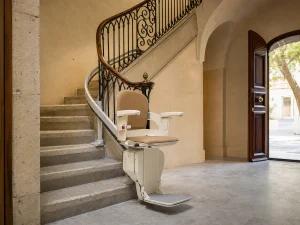
Installing a new lift is one of the accessibility works eligible for the grant, along with stairlifts, ramps and automatic door opening. So are several improvements to an existing lift, which match those required by Royal Decree 355/2024.
- Two-way communication in the lift car and alarm devices for emergencies or entrapment.
- Improved levelling of the lift car and other safety-in-use features.
- Complementary works on elements directly related to the improvement of accessibility.
In other words, the grant can be used both to install a lift where there isn't one and to adapt an old one. If yours is the second case, you'll find the details on our page about the modernisation of lifts in Mallorca.
How do I apply for a lift grant in the Balearic Islands, step by step?
- Approve the work at the owners' meeting, with the agreement recorded in the minutes.
- Commission the technical project and the Existing Building Logbook.
- Ask a licensed installation company for a fixed-price quote.
- Submit the application under the Balearic Government's call for applications, through the CAIB online portal and before the deadline.
- Carry out the work within the period set in the grant decision: no more than 36 months from the date the grant is awarded.
- Back up the expenditure with invoices, certificates and proof of payment to receive the grant.
The grant is paid once the work is finished and fully documented, although the Balearic Government can pay part of it in advance if the community provides the building permit and the start-of-works certificate signed by the architect. In the meantime, the community pays the cost up front, which is why many communities take out financing for the work. Each call for applications sets its own deadlines and whether it accepts work that has already started, so it's best not to sign the building contract until you've read it.
Can a tax deduction be added to the lift subsidy?
Depending on each owner's circumstances, the share of the special levy that they pay may entitle them to personal income tax (IRPF) deductions. The conditions depend on each taxpayer and change from year to year, so it's worth checking them with whoever prepares your tax return. We explain it with examples in our guide to deducting the special levy for the lift.
What is certain is that both the grant and the deduction are calculated on what the community actually pays, so a clear quote, broken down item by item, is the basis of the whole application.
Where are the calls for applications for lift grants published in the Balearic Islands?
In the Official Gazette of the Balearic Islands (BOIB) and on the CAIB online portal, which is where applications are submitted. The State Housing Plan 2026-2030 leaves the call for applications to each autonomous community, so the deadlines, the documents required and the order in which grants are awarded are set by the Balearic Government's call for applications.
The practical approach is to have the owners' meeting agreement, the project and the quote ready before the call opens. If your community is in Mallorca and wants to be ready in time, we can help you with the whole technical side: we are a lift company in Mallorca with our own technicians.
Frequently asked questions about lift subsidies in the Balearic Islands
Can you apply for the lift grant if the work has already started?
It depends on the call for applications. The State Housing Plan 2026-2030 leaves the call for applications to each autonomous community, and it is the call that sets whether work that has already started is accepted. So before signing the building contract or paying the first invoice, it's worth checking which start date the Balearic Government's call for applications accepts.
When is the grant for installing a lift paid?
Once the work is finished and the expenditure has been documented, according to Royal Decree 326/2026. The Balearic Government can pay part of it in advance if the community provides the building permit and the start-of-works certificate signed by the architect. In the meantime, the community pays the cost up front, so it's best to arrange the financing before work starts.
How much can the subsidy cover for each home in the building?
Up to €13,000 per home in the general case, €18,000 if someone over 65 or with a disability of at least 33% lives in the building, €20,500 if the disability is at least 65% and €22,000 if the work makes the building fully accessible. Always within the limit of 70% of the cost, which rises to 80% if there are older residents or residents with a disability.
Does the grant cover the modernisation of an existing lift?
Yes, in part. The State Housing Plan 2026-2030 includes among its accessibility works two-way communication in the lift car, alarm devices and improved levelling, which are improvements required by Royal Decree 355/2024. Regular maintenance, on the other hand, is not eligible: the community of owners pays for it as the owner of the lift.
Would you like to know if your community can apply for the grant?
At Eleva Balear we prepare the technical side of the application: the building survey, the fixed-price quote broken down item by item and the lift documentation. The administrative side, such as the minutes of the owners' meeting, is prepared by the property manager or the community itself, and we coordinate it with you. Call us on 971 17 81 51 or email us at quierosercliente@elevabalear.com and we'll look into it with no obligation. Experience the peace of mind of being in good hands.