Installing a lift in Mallorca costs between €25,000 and €90,000 in 2026, depending on the building's condition. With usable stairwell space, a four-storey building will cost between €30,000 and €50,000. Without stairwell space, and with the lift structure located in an interior courtyard, the cost rises to €45,000-€75,000, and a listed building in the centre of Palma can exceed these figures. From these amounts, Balearic government subsidies, which cover a significant portion of the cost, must be deducted.
The first question at any residents' meeting is always the same. And it almost never has a single-figure answer. When someone asks how much it costs to install a lift in Mallorca, what they are really asking is what their own building will pay, and that depends on whether there is a shaft, how many floors have to be served, whether the building is listed and how the materials get in. In 2026, with civil works prices still under pressure on the island, the difference between the easy case and the complicated one is more than €50,000. Here is the real breakdown, item by item, with what makes the works more expensive specifically in Mallorca.
How much does it cost to install a lift in Mallorca in 2026?
Installing a lift in Mallorca costs between €25,000 and €90,000 in most residential projects in 2026. The most important factor is not the brand of the equipment or the number of stops: it's whether the building has a usable shaft. With a shaft, the work is predictable. Without one, the shaft has to be built, and the budget increases significantly.
These are the indicative price ranges we use for a community in Mallorca:
| Property situation | Stops | 2026 price range |
|---|---|---|
| Usable stairwell | 3 | €25,000 – €38,000 |
| Usable stairwell | 4-5 | €30,000 – €50,000 |
| No shaft, structure in interior courtyard | 3 | €40,000 – €60,000 |
| No shaft, structure in interior courtyard | 4-5 | €45,000 – €75,000 |
| Listed building or building with heritage protection | 3-5 | from €60,000 |
These are figures for the complete project: equipment, installation, civil works, technical project, and legalisation. They do not include the reduced VAT for accessibility works, nor do they deduct subsidies, which are separate and can completely change the final result.
What items are included in the price and which are paid separately?
The cost of a lift is divided into five items, and the one that significantly increases the total is almost never the machine itself. The equipment typically accounts for between 30% and 45% of the total cost in a building without a shaft; the remainder is for construction and permitting.
- Lifting equipment: cabin, machinery, doors and control system. From €12,000 to €25,000 depending on stops and finishes.
- Civil works: shaft opening, structural reinforcement, pit and enclosure. This is the most variable item, from €8,000 to €45,000.
- Technical project and construction management: signed by a qualified technician and officially endorsed where applicable. Between €1,500 and €4,000.
- Municipal building permit: in Palma and in most Mallorcan municipalities, from €800 to €3,000 depending on the execution budget.
- Legalisation and commissioning: registration of the unit, RAE number and initial inspection. Around €600–€1,200.
There are almost always three things not included in the price that you should ask about before signing: the replacement of staircase finishes, the relocation of utilities (water, gas, meters), and the rental of scaffolding if the work is outdoors. Request these in writing in the quote, or they will appear later.
Why does installing a lift cost more in Mallorca than on the mainland?
The same project costs on average between 8% and 15% more in Mallorca than in a mainland capital, and it is not a question of margins. Three logistical factors pile up.
The first is transport. All the equipment arrives by ship, and a cabin doesn't travel in a package: freight and port handling costs are noticeable in the budget, especially in single-unit projects, where there is no volume to spread the cost.
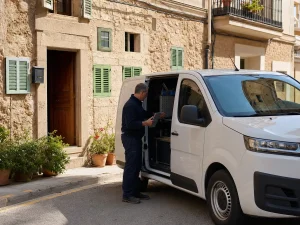
The second issue is access. Half of Mallorca was built before crane trucks existed. In the centre of Palma, in Sóller, or in the old town of Inca, the streets don't allow heavy machinery, there are designated times for noise and loading, and materials are delivered in short bursts. This lengthens the process, and delays cost money.
And the third factor is skilled labour. During the high season, construction in the Balearic Islands competes for the same teams as hotel refurbishments. Between April and October lead times get longer, and work contracted in winter usually gets a better price.
How much does it cost to install a lift in a listed building in the centre of Palma?
In a listed building in the centre of Palma, the project starts at 60,000 euros and can exceed 100,000. The difference is not in the lift, but in what the heritage protection requires to be done around it.
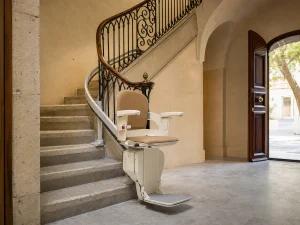
These buildings require a prior heritage report, and the technical solution must respect protected elements: the original stairwell, the railing, the hydraulic tiles, and the courtyard. Often, the stairwell is ruled out, and an interior courtyard or the rear façade must be used, with a self-supporting structure and glazed enclosure. The administrative process is also lengthened because a heritage commission is involved in addition to the city council.
It's not a blank cheque, and it's worth stating this: there are protected properties where the installation is perfectly feasible and reasonably priced. What you can't do is provide a quote for one of these projects without a prior site visit. Anyone who gives you a price over the phone for a listed building is making it up. We discuss this in more detail in our guide on installing a lift in an old building without a lift in Palma.
How is the cost of the lift divided among the residents?
The cost is distributed according to the participation coefficient, unless the board unanimously agrees otherwise. This is what the Horizontal Property Act, and this is where most residents' meetings get stuck: the ground-floor neighbour asks why they should pay for a lift they will never use.
The legal answer is that they do pay, because the lift is a common element and adds value to the whole building. From there, there are two different situations. If the owners' meeting approves the installation by a majority of owners who also represent a majority of the ownership shares, the community is obliged to pay for it even if the special levy exceeds twelve monthly instalments of community fees. And if it is requested by an owner in whose home someone over 70 or with a disability lives, it is compulsory without a vote, provided that the annual levy, after deducting grants, does not exceed those twelve monthly instalments.
In practice, many communities in Mallorca settle this with an agreed split that reduces the ground-floor share in exchange for giving up use. It is valid if approved unanimously and recorded in the minutes. If there are doubts in your building about who pays for what, we have an article devoted to whether ground-floor flats pay for the lift.
Can a community of owners finance the installation of a lift?
Yes, and it is the most common approach: the community takes out a loan or agrees a special levy payable in instalments, and each owner pays a monthly instalment instead of a lump sum. For compulsory accessibility works, article 10 of the Horizontal Property Act calculates the limit of twelve monthly instalments by spreading the cost over as many years as the financing lasts.
As a general rule, public grants are paid once the work is finished and the costs have been justified, so the community has to pay upfront in the meantime. It is best to have the financing arranged before you start. When we give you the quote, we at Eleva Balear also explain the financing options.
What subsidies reduce the final price in the Balearic Islands in 2026?
From April 2026, the State Housing Plan 2026-2030 sets the accessibility grants for buildings: up to 70% of the cost of installing a lift, and up to 80% if someone over 65 or with a disability lives in the building, with a maximum of between 13,000 and 22,000 euros per home depending on the case. The calls are issued by the Balearic Government, and some town councils have their own schemes.
There are two things worth being clear about. First: each call sets its own deadlines and whether the grant has to be applied for before work starts, so it is best to have the quote and the project ready before the owners' meeting. Second: the grant is shared only among the homes that are the main residence of the people living in them, which in Mallorca, with so many second homes, changes the sums. We have gathered all the open schemes, requirements and deadlines in our guide to grants and subsidies for installing a lift in the Balearic Islands in 2026, which we update every time a new call for applications is published.
VAT also matters: accessibility works in homeowners' associations are taxed at the reduced rate when they meet the requirements of the Tax Agency, and on a budget of 50,000 euros that is already a difference of several thousand.
How much does it cost to maintain the lift once it's installed?
Lift maintenance in Mallorca costs between €60 and €140 per month per unit, depending on the type of contract and the number of stops. It's a recurring expense that must be factored in from the outset, as it accompanies the lift throughout its entire lifespan.
In addition, there is the mandatory periodic inspection, which is contracted by the community to an independent control body —never the maintenance company— and which in a residential building is due every four or six years depending on the size of the property, as established by ITC AEM 1 of the Royal Decree 355/2024. You can see the details in our guide about how much lift maintenance costs per year.
Frequently asked questions about the price of installing a lift in Mallorca
How much does it cost to install a lift in a 4-storey building in Mallorca?
Between 30,000 and 50,000 euros if there is usable space in the stairwell, and between 45,000 and 75,000 euros if the shaft has to be built in an inner courtyard. The range includes equipment, building work, project and legalisation, but does not deduct grants. In a four-storey building with eight or ten owners, and with the Balearic grants applied, the special levy per home is usually well below what people first estimate.
Is it mandatory to install a lift in an old building in Palma?
It is compulsory when it is requested by an owner in whose home someone over seventy or with a disability lives, and the annual special levy, after deducting public grants, does not exceed twelve monthly instalments of ordinary community fees. In that case, the community cannot refuse by voting. Outside that case, the installation requires the agreement of a majority of the owners who also represent a majority of the ownership shares.
How long does it take to install a lift in Mallorca?
The work inside the building takes between three and six weeks when there is usable space for the shaft. The whole process, including the project, the municipal permit and the manufacture of the lift, takes three to six months, and five to eight if the structure has to be built or the building is heritage-protected. On top of that comes the time the community takes to decide: counting only the building work is the most common planning mistake.
Is it possible to install a lift without a stairwell?
Yes. When there's no space available, a self-supporting structure is used in an interior courtyard, on the rear facade, or, in some cases, by occupying part of the landing if the staircase allows, while maintaining the minimum evacuation width. There are also solutions without a pit or with a reduced pit for properties where excavation is not possible. Feasibility is always determined by a technical study of the property, not a catalogue.
Can the special levy for a lift be paid in instalments in a community of owners?
Yes. The owners' meeting can agree a special levy in several instalments or take out a loan in the community's name, so that each owner pays a monthly instalment. For compulsory accessibility works, if the community finances the work, the limit of twelve monthly instalments is calculated by spreading the cost over the years of the financing. Public grants are paid when the work is finished, so you need to plan for that advance payment.
Request a Real Quote for Your Building
The figures in this article are meant to give the board an idea, but no lift quote is given without seeing the building. At Eleva Balear, we have installed over one hundred lifts in the Balearic Islands and we offer a free technical visit and quote: we measure the shaft, assess the solution, and clearly explain what financial assistance is available for your situation and the cost per resident. We are lift company in Mallorca with our own technical service on the island, the person who visits you is the one who will carry out the work. Call us at 971 17 81 51 or write to us and we'll take a look. If you're already sure you want to move forward, you can start with our service of installation of lifts in Mallorca.