In the Balearic Islands, there are three funding options available for installing a stairlift in 2026: the regional accessibility program from the Ministry of Social Affairs, financed with Next Generation EU funds, which has provided up to €74,100 per homeowners' association; the State Housing Plan, which covers between 40% and 75% of the cost; and the reduced VAT rate of 4% when a disability certificate is available. A straight stairlift starts at €1,800-€2,750 and a curved platform lift at €5,500-€6,000, so the funding can cover up to half of the installation cost.
Almost all the online guides to stairlift grants are written for Castile and León, Madrid, or Andalusia. If you live in Mallorca, Menorca, or Ibiza, none of them will be entirely relevant: the grant programs are managed by each regional government, the deadlines are set by each community, and the requirements vary from one to another.
This guide outlines what can actually be requested from the Balearic Islands in 2026, with figures from the latest completed calls for applications, and clarifies the most frequently asked question: whether the aid is requested by the homeowners' association or by the person who will use the stairlift, because it is not the same grant nor the same procedure.
The context explains why this matters so much here. According to the first Accessibility Barometer of the Mutua de Propietarios Foundation, from 2026, only the 2 % of the buildings in the Balearic Islands is fully adapted for people with reduced mobility, 98 % have at least one architectural barrier between the street and the home, and 48 % have steps at the entrance. That step at the entrance is, precisely, the typical case for a stairlift platform.
What subsidies are available for installing a stairlift in the Balearic Islands in 2026?
There are three options, and they can be combined. The main one is the regional call for proposals for accessibility improvements for homeowners' associations, which is managed by the Department of Social Affairs of the Government of the Balearic Islands with European Next Generation funds within the Recovery, Transformation and Resilience Plan.
- Regional call for accessibility (CAIB). It covers refurbishment of lobbies and entrance halls, construction of ramps and installation of lifts, stairlifts and other lifting platforms. In the last resolved call, €808,468 was shared among 43 residents' associations, with a maximum of €74,100 each. Thirty-two associations in Mallorca, six in Menorca and five in Eivissa received the grant.
- State Housing Plan. Its accessibility program generally covers 40% of the investment, which increases to 75% when the applicant's income is less than three times the IPREM, when a person with a disability or over 65 years of age lives in the building, or when the property is in a declared Urban Regeneration and Renewal Area.
- Tax advantages. The VAT rate for the installation drops to 4% when there is a disability certificate and the work is for accessibility, compared to 10% for a standard renovation. It's not a subsidy, but on an installation costing €6,000, that's a difference of €360.
In addition, there are occasional municipal grants from some town councils and private lines such as those from the Mutua de Propietarios Foundation, which in 2026 opened a call for 50% of the costs of accessibility works with a maximum of 15,000 euros per community.
Who requests the help: the homeowners' association or the individual?
It depends on where the stairlift is installed, and this is the distinction that rejects most applications. If the device is in a common area—the entrance hall, the building's staircase, the access from the street—the applicant is the community of owners, with its tax identification number, its board agreement, and its representative. If it is inside a dwelling, on an interior staircase, the applicant is the owner or user.
The regional accessibility grant programs in the Balearic Islands that we have seen resolved are aimed at homeowners' associations in buildings where at least one person over 65 years of age resides, with a recognised disability of any degree, or in a situation of dependency. In other words: not all the residents need to meet the requirement, it is enough that one of them does, and that is the point many residents' associations are unaware of, which leaves them without applying for grants they were entitled to.
In the case of single-family homes, the usual route is the state accessibility program and the benefits for assistive products, in addition to the super-reduced VAT.
How much does the grant cover and how much do you end up paying?
With regional accessibility funding, a community can have approximately half of the installation covered; with the State Plan, between 40% and 75% of the cost. For a stairlift platform at the entrance costing €6,000, this leaves a contribution from residents of between €1,500 and €3,600, distributed through participation fees.
| Concept | Indicative amount 2026 |
|---|---|
| Straight stairlift chair (installation included) | €1,800 – €2,750 |
| Curved stairlift | from €6,000 |
| Stairlift platform | €5,500 – €5,900 |
| Coverage of regional accessibility aid | up to 50 % |
| Coverage of the State Housing Plan | 40 % – 75 % |
| VAT with disability certificate | 4 % instead of 10 % |
There is one treasury detail that should be kept in mind from the beginning: the administration pays against proof of expenditure, that is, after the work has been carried out and paid for. Between the favourable decision and the actual payment, eight to fourteen months usually pass. The residents' association must be able to advance the money, and that is decided at the meeting at the same time as the work, not afterwards.
The full price breakdown is in the article about how much a stairlift costs.
What requirements must be met for the aid to be approved?
The requirements that are repeated in the Balearic calls for proposals are four, and it is advisable to check them before requesting a quote:
- Resident profile: at least one person over 65 years of age, with a recognised disability or in a situation of dependency, registered in the building.
- Use of the property: main residence, not second home or tourist rental.
- Work not yet started: the application is submitted before before starting the work. This is why most applications fall through: the device is installed and then help is requested, and then there is no help left.
- Technical documentation: detailed budget, agreement of the owners' association in the case of common areas and, where applicable, certificate of disability or dependency.
How do I request help step by step?
- Check in the CAIB grants portal whether there is an open accessibility call and what the submission deadline is.
- Gather the resident's documentation that entitles them to the aid: disability certificate, dependency resolution or proof of age and registration.
- Request a detailed quote from a qualified company, specifying the exact model of stairlift and the necessary work.
- Take the matter to the owners' meeting if the appliance is to be installed in a common area and record the agreement.
- Submit your application electronically within the deadline and before starting the installation.
- Carry out the work once the concession has been granted and submit the invoices and proof of payment within the justification period.
If something gets stuck, the point of contact is the Ministry of Social Affairs itself. And if the question is technical—what kind of device fits on your staircase—we'll sort that out during a visit.
What tax relief is available for a stairlift?
The most direct and secure tax advantage is VAT: accessibility works for people with disability certificates are taxed at 4 % instead of the 10 % that applies to an ordinary renovation. It is requested from the installation company before the invoice is issued, providing the certificate.
There is also an income tax deduction for works and installations to adapt a primary residence due to disability, amounting to 10% of the national tax plus the regional tax portion, with a maximum annual base of €12,080. This deduction can also be claimed by co-owners who finance modifications to common elements such as staircases or lifts. Its application is subject to a transitional regime with specific dates, so it is advisable to confirm this with the Tax Agency or an advisor before including it in your budget. The exact conditions are published in the electronic office of the Spanish Tax Agency.
How much does a stairlift cost in Mallorca before subsidies?
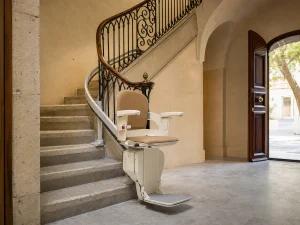
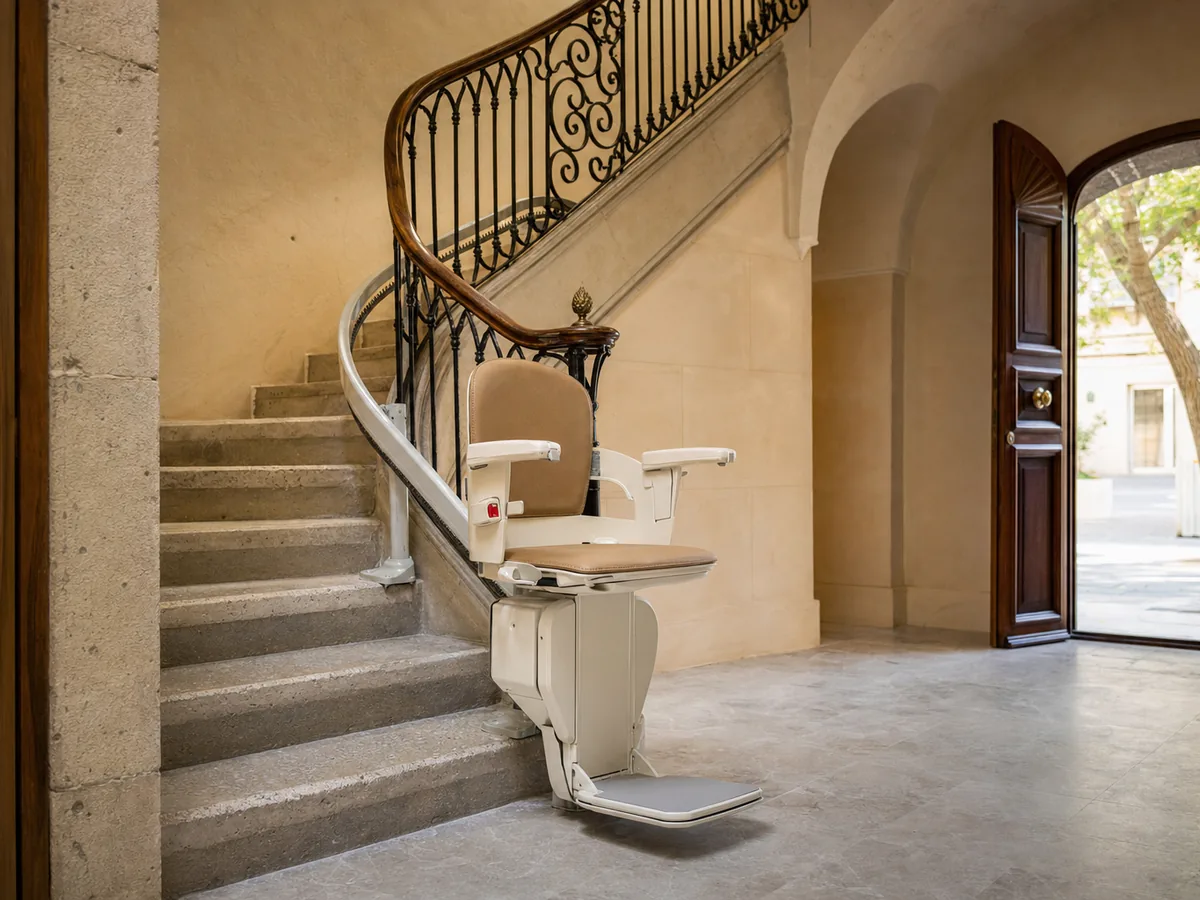
A stairlift for a straight staircase starts at €1,800-€2,750 with installation included, and a curved one—custom-made to the actual layout of the staircase—starts at around €6,000. A wheelchair platform averages between €5,500 and €5,900.
What makes the price difference is the geometry of the staircase, not the brand of the device. A straight, single-flight staircase can accommodate a standard guide rail; a spiral staircase or one with multiple landings requires a custom-made guide rail, and that's where the price doubles. That's why no online price is reliable without a measurement: the staircase needs to be seen.
In the stairlift catalogue the models we work with are listed on the page stairlifts in Palma de Mallorca we explain how the installation works.
Frequently asked questions about stairlift subsidies in the Balearic Islands
Can I apply for a grant for a stairlift if I've already installed it?
No. Accessibility grants require that the work not have started at the time of application, and this is the most frequent reason for rejection. If the device is already installed, the only remaining option is tax relief: the reduced VAT rate cannot be recovered later, but the income tax deduction for accessibility improvements can be applied to the tax return for the year in which the work was paid for, provided the requirements are met.
Can the community refuse to install a stairlift in the building entrance?
In accessibility improvements requested by a person with a disability or over 70 years of age, the Horizontal Property Law obliges the community to carry them out when their cost does not exceed twelve ordinary monthly common expenses, excluding subsidies. If it exceeds that amount, a resolution from the board is required, although the applicant can assume the excess and carry out the improvements anyway.
How long does it take to receive the accessibility grant in the Balearic Islands?
Between approval and receipt of the funds, eight to fourteen months typically elapse because the administration pays only upon receipt of supporting documentation: first, the work is completed and paid for; then, the invoices are submitted; and finally, the grant is disbursed. The community must budget for these expenses when approving the project at a meeting.
Is a stairlift or a lift better if there are aids available for both?
It depends on the building and the route. A stairlift solves a specific level difference—the entrance step, a flight of stairs—with minimal construction, no pit, and in a single day. A lift provides access to all floors, but requires shaft space, construction work, and an investment ten times greater, whether for a new installation or a refurbishment modernisation of existing equipment. In two- or three-story buildings without available stairwell space, a stairlift is often the only viable option. We compare them in detail in stairlift or lift: which one to install.
When it's NOT worth waiting for the grant
If someone in your household can no longer manage the stairs, waiting nine months for a grant application isn't always reasonable. There are three clear scenarios: when the need is immediate and the alternative is for the person to remain at home; when the installation cost is low—a straight wheelchair costing €2,000—and the grant percentage doesn't compensate for the waiting time and paperwork; and when the building doesn't meet the residency requirements, because the application will likely be denied anyway. In these cases, the most effective solution is financing, not a grant.
We'll tell you which stairlift fits your staircase
Before wrestling with a grant call it is worth knowing what equipment your building takes and how much it really costs. At Eleva Balear we go and see it, measure the staircase and give you an itemised quote that works as it is for submitting the application. We are specialists in lifts and stairlifts in Mallorca, with our own technical service on all the islands. Call us at 971 17 81 51 or write to us at quierosercliente@elevabalear.com.