Today, many lifts in Spain are at least 25 years old. For this reason, lift inspection is not only a recommended procedure but also required by law to ensure user safety and avoid fines.
However, this work may not be familiar to everyone, so here we'll give you all the details on why maintenance is essential and what technical aspects it includes. Don't miss a single detail! At Eleva Balear, we take care of the installation, maintenance and repair of lifts in the Balearic Islands on the four islands.
Why is a lift inspection important?
Lifts are practical and indispensable tools in daily life in cities, where more than 60% of residential buildings have more than three floors.
However, for these to operate safely and efficiently, it depends not only on a good installation, but also on the periodic inspection of a lift.
Safety and accident prevention
By 2023, a certain percentage of emergencies reported in residential communities in Spain were related to lift failures, such as worn cables or faulty brakes.
Therefore, the first line of defense against accidents of this type is lift inspection and maintenance, detecting problems such as:
● Door misalignment (responsible for 23% of the bull runs).
● Loss of lubrication in engines (common cause of overheating).
● Corrosion in metal components, especially in coastal areas.
Without proper inspection of a professional lift, these failures can lead to critical situations, such as getting trapped between floors or sudden falls from the cabin.
Regulations and legal compliance
Royal Decree 88/2023 stipulates that each homeowners' association must inspect their lifts at least once a year, or every six months if the equipment is more than two decades old. Ignoring this obligation not only puts lives at risk but can also result in financial penalties.
Extending the life of the lift
A well-maintained lift can last more than 30 years, reducing the risk of breakdowns in a 60%. Therefore, maintenance services include preventive adjustments, such as sensor calibration or bearing replacement, which prevent premature wear.
How often should a lift be serviced?
The answer to this question depends on several factors; we detail each of them below:
Periodic review according to regulations in Spain
The frequency of lift inspection depends on two main factors:
- Age of equipment:
● Lifts less than 20 years old: 1 annual inspection.
● Lifts older than 20 years: 2 annual inspections (every 6 months). - Intensive use:
Lifts in hospitals, shopping centres, or buildings with more than 15 floors require quarterly inspections.
Factors that may influence review frequency
● Environmental setting: In coastal areas, salinity accelerates corrosion, requiring inspections every 4 months.
● Outdated technology: Lifts without digital systems require more frequent checks.
● Previous incidents: If a lift has suffered a serious breakdown, an extraordinary inspection is recommended before reactivating it.
What is checked during lift maintenance?
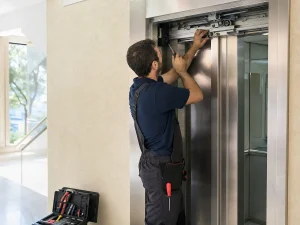
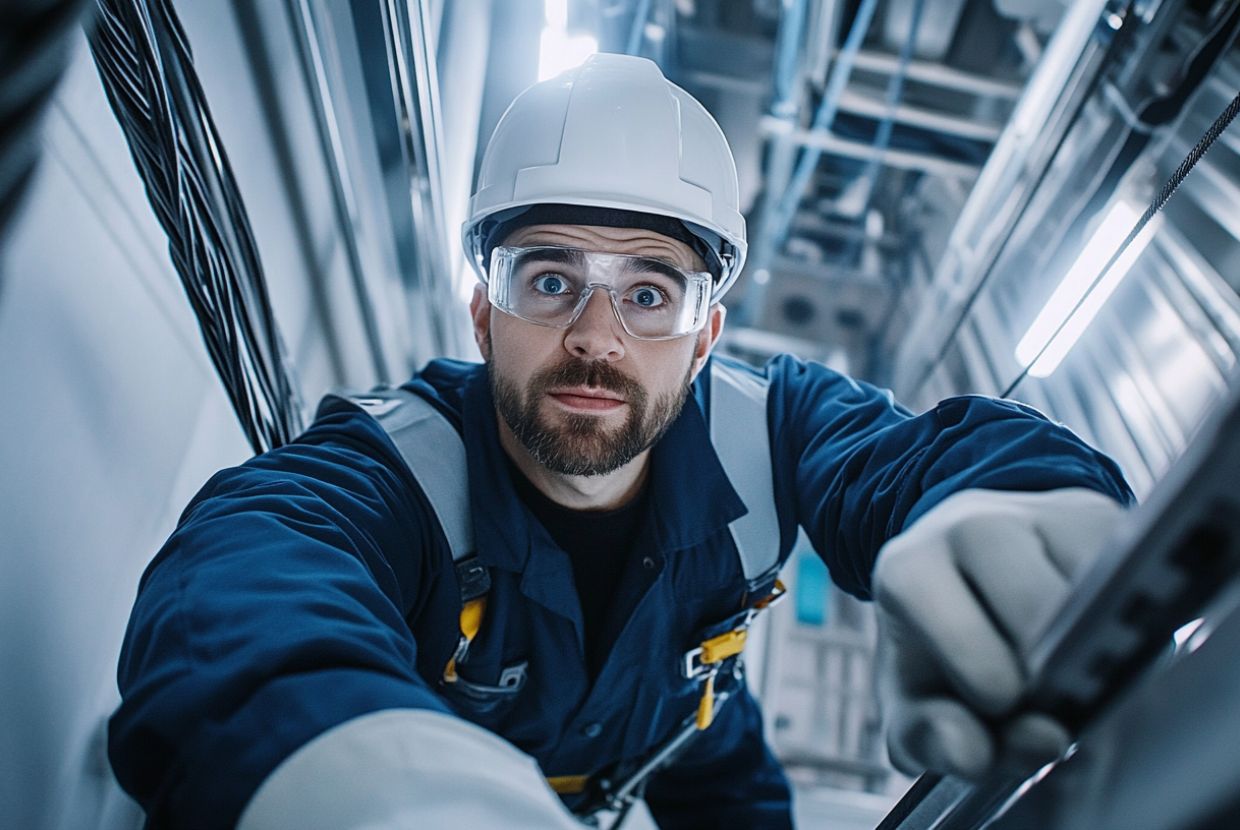
In this case, specialised technicians, like those at Eleva Balear, evaluate up to 35 critical points during a lift inspection. The most important are:
Mechanical and electrical components
● Motor and electrical panel: verification of energy consumption and operating temperature.
● Traction cables: visual and ultrasonic inspection to detect internal breaks.
● Bearings and pulleys: lubrication and vibration measurement (must not exceed 4 mm/s).
Security and emergency systems
● Safety brakes: automatic locking test in case of falls (must be activated in less than 0.5 seconds).
● Alarm button: 24-hour connection check with the switchboard.
● Emergency lighting: minimum autonomy of 1 hour.
Doors, cables and braking system
● Anti-pinch sensors: test with 50 mm thick obstacles.
● Cabin leveling: maximum deviation margin: ±10 mm from the ground.
● Hydraulic oil: in hydraulic lifts, viscosity and contamination analysis.
Each of these points is key to the proper functioning of a lift, so it's important to have professionals who guarantee optimal and reliable work.
Consequences of not inspecting a lift
Failure to inspect a lift not only halts routine maintenance but also increases the risk of accidents, and the economic consequences would undoubtedly be very costly.
Fines and penalties for non-compliance with regulations
The Horizontal Property Law (art. 17.2) establishes that omitting this process in a lift is considered a serious offense, with fines ranging from €1,001 to €10,000.
In extreme cases, such as falsifying lift inspection certificates, fines can reach €30,000, in addition to criminal liability for damages to third parties.
Risks of accidents and malfunctions
Avoiding this procedure increases the likelihood of having an accident by seven times. The most common are:
● Falls into the pit due to poorly calibrated doors.
● Short circuits in non-ventilated electrical panels.
● Prolonged blockages due to failures in rescue systems.
High costs for major repairs
Ignoring lift inspections leads to costly breakdowns. For example, replacing a worn traction cable on time costs €800, but if it breaks and damages the motor, the repair costs over €6,000.
At Eleva Balear we are specialists in lifts
Our priority is to ensure your safety! In the Balearic Islands, where the 70% lifts operate in buildings with high exposure to the sea and high humidity.
Lift inspection requires experience and advanced technology. Thus, at Eleva Balear, Lift specialists in Mallorca, we offer:
● Predictive maintenance: We use IoT sensors to monitor wear and tear in real time.
● Official certificates: We issue documents that are valid for inspections by the Balearic Government.
● 2-hour response: 24/7 emergency service for residential communities. Don't let these problems affect you. Each of our projects is performed by qualified personnel using state-of-the-art technology, responding quickly to each situation.
We are your best option in Lift inspection in MallorcaContact us and we'll give you personalised attention. If you want to know more how often the inspection falls due in the Balearic Islands and how to check it with the RAE number, we explain it step by step.